
Local Provider Extension
The "local provider" extension is used to allow the usage of seed and shoot clusters which run entirely locally without any real infrastructure or cloud provider involved. It implements Gardener's extension contract (GEP-0001) and thus comprises several controllers and webhooks acting on resources in seed and shoot clusters.
The code is maintained in pkg/provider-local.
Motivation
The motivation for maintaining such extension is the following:
- 🛡 Output Qualification: Run fast and cost-efficient end-to-end tests, locally and in CI systems (increased confidence ⛑ before merging pull requests)
- ⚙️ Development Experience: Develop Gardener entirely on a local machine without any external resources involved (improved costs 💰 and productivity 🚀)
- 🤝 Open Source: Quick and easy setup for a first evaluation of Gardener and a good basis for first contributions
Current Limitations
The following enlists the current limitations of the implementation. Please note that all of them are not technical limitations/blockers, but simply advanced scenarios that we haven't had invested yet into.
No load balancers for Shoot clusters.
We have not yet developed a
cloud-controller-managerwhich could reconcile load balancerServices in the shoot cluster.Machines/nodes are recreated during control plane migration.
Since the machine provider creates
Pods for the shoot worker nodes in the shoot's control plane namespace, they get deleted and recreated on the other seed cluster during control plane migration.
ManagedSeeds
It is possible to deploy ManagedSeeds with provider-local by first creating a Shoot in the garden namespace and then creating a referencing ManagedSeed object.
Please note that this is only supported by the
Skaffold-based setup.
The corresponding e2e test can be run via:
./hack/test-e2e-local.sh --label-filter "ManagedSeed"Implementation Details
The Gardener images built locally by Skaffold are pushed to/pulled from a container registry in the kind network managed by docker-compose (registry.local.gardener.cloud:5001). The registry is accessible from the host on 127.0.0.1:5001 and [::1]:5001. provider-local configures this registry as mirror for the shoot by mutating the OperatingSystemConfig and using the default contract for extending the containerd configuration.
In order to bootstrap a seed cluster, the gardenlet deploys PersistentVolumeClaims and Services of type LoadBalancer. While storage is supported in shoot clusters by using the local-path-provisioner, load balancers are not supported yet. However, provider-local runs a Service controller which specifically reconciles the seed-related Services of type LoadBalancer. This way, they get an IP and gardenlet can finish its bootstrapping process. Note that these IPs are not reachable, however for the sake of developing ManagedSeeds this is sufficient for now.
Also, please note that the provider-local extension only gets deployed because of the Always deployment policy in its corresponding ControllerRegistration and because the DNS provider type of the seed is set to local.
Implementation Details
This section contains information about how the respective controllers and webhooks in provider-local are implemented and what their purpose is.
Bootstrapping
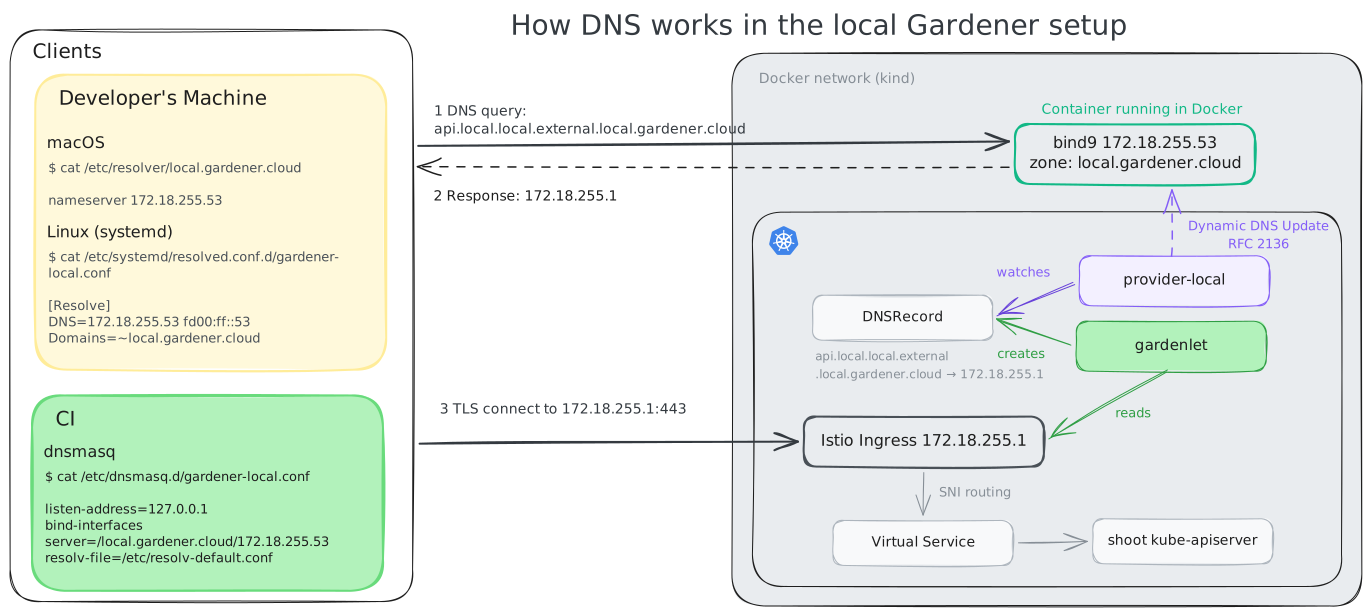
The local setup includes a BIND9 DNS server running as a Docker container in the kind network (accessible from the host on 172.18.255.53:53 and [fd00:ff::53]:53). This DNS server is authoritative for the local.gardener.cloud zone and accepts RFC 2136 dynamic DNS updates. It is responsible for hosting all DNS records of the local setup and enabling clients on the host and components running in the seed/kind and shoot clusters to resolve them.
The kind cluster nodes are configured to use the local DNS server as their DNS resolver (via a custom /etc/resolv.conf), so all nodes and pods of the cluster can resolve names in the local.gardener.cloud zone. Machine pods created by provider-local are configured to use the same DNS server as the kind nodes (dnsPolicy=Default), i.e., talk directly to the BIND9 server without going through the kind cluster's coredns.
Clients on the host machine can resolve names in the local.gardener.cloud zone by using conditional forwarding in their DNS configuration. On macOS, this is achieved by creating a file /etc/resolver/local.gardener.cloud pointing to the local DNS server (see this blog post). On Linux systems using systemd-resolved, this is achieved by creating a file in /etc/systemd/resolved.conf.d/ including the Domains=~local.gardener.cloud directive. In e2e tests running in CI (prow), this is achieved by running dnsmasq in the test pod and configuring it to forward requests for the local.gardener.cloud zone to the local DNS server.
Credentials
By default, provider-local doesn't require any cloud provider credentials in the shoot's {Secret,Credentials}Binding as all infrastructure resources are deployed in the cluster where it runs. For this, provider-local uses its in-cluster config to connect to the Kubernetes API server of the seed/bootstrap cluster. However, provider-local also supports overwriting the credentials by specifying a kubeconfig in the shoot credentials secret. This is used in the local setup for self-hosted shoots with managed infrastructure. Here, provider-local initially creates the infrastructure resources (e.g., Service, NetworkPolicies, machine Pods, etc.) in the kind cluster (during gardenadm bootstrap). Later on, gardenadm init restores the extension resources within the self-hosted shoot cluster itself, and provider-local – running in the shoot cluster now – needs credentials to access the kind cluster API server to keep managing those resources.
Controllers
There are controllers for all resources in the extensions.gardener.cloud/v1alpha1 API group except for BackupBucket and BackupEntrys.
ControlPlane
This controller is deploying the local-path-provisioner as well as a related StorageClass in order to support PersistentVolumeClaims in the local shoot cluster. Additionally, it creates a few (currently unused) dummy secrets (CA, server and client certificate, basic auth credentials) for the sake of testing the secrets manager integration in the extensions library.
DNSRecord
The controller manages DNS records by sending RFC 2136 dynamic DNS updates to the local BIND9 server (see Bootstrapping). For each DNSRecord, it sends an UPDATE message that first removes any existing resource record set for the FQDN and record type and then inserts the new records based on DnsRecord.spec.values.
For example, for a shoot with API server domain api.local.local.internal.local.gardener.cloud, the controller sends an update adding A records pointing to the IP addresses specified in the DNSRecord's values.
The controller supports A, AAAA, and CNAME record types.
Infrastructure
This controller generates a NetworkPolicy which allows the control plane pods (like kube-apiserver) to communicate with the worker machine pods (see Worker section). It also deploys a NetworkPolicy which allows the bastion pods to communicate with the worker machine pods (see Bastion section).
Network
This controller is not implemented anymore. In the initial version of provider-local, there was a Network controller deploying kindnetd (see release v1.44.1). However, we decided to drop it because this setup prevented us from using NetworkPolicys (kindnetd does not ship a NetworkPolicy controller). In addition, we had issues with shoot clusters having more than one node (hence, we couldn't support rolling updates, see PR #5666).
OperatingSystemConfig
This controller renders a simple cloud-init template which can later be executed by the shoot worker nodes.
The shoot worker nodes are Pods with a container based on the kindest/node image. This is maintained in the pkg/provider-local/node directory and has a special run-userdata systemd service which executes the cloud-init generated earlier by the OperatingSystemConfig controller.
Worker
This controller leverages the standard generic Worker actuator in order to generate the MachineClasses and the MachineDeployments based on the specification of the Worker resource.
Additionally, the controller deploys RBAC objects for granting machine-controller-manager additional permissions in the namespace of the machine pods. This is needed because the local machine provider creates Kubernetes objects for starting Machines, which is different to all other machine provider implementations.
Bastion
This controller implements the Bastion.extensions.gardener.cloud resource by deploying a pod with the local machine image along with a LoadBalancer service.
Note that this controller does not respect the Bastion.spec.ingress configuration as there is no way to perform client IP restrictions in the local setup.
Service
This controller reconciles Services of type LoadBalancer in the local Seed cluster. Since the local Kubernetes clusters used as Seed clusters typically don't support such services, this controller sets the .status.ingress.loadBalancer.ip[0] to magic 172.18.255.* or fd00:ff::* IP addresses that are added to the loopback interface of the host machine running the kind cluster. It makes LoadBalancer Services (e.g. istio-ingressgateway and shoot--*--*/bastion-*) available to the host by setting spec.ports[].nodePort to well-known ports that are mapped to hostPorts in the kind cluster configuration.
istio-ingress/istio-ingressgateway is set to be exposed on nodePort 30433 by this controller. The bastion services are exposed on nodePort 30022.
In case the seed has multiple availability zones (.spec.provider.zones) and it uses SNI, the different zone-specific istio-ingressgateway loadbalancers are exposed via different IP addresses. Per default, IP addresses 172.18.255.1{0,1,2} and fd00:ff::1{0,1,2} are used for the zones 0, 1, and 2 respectively.
ETCD Backups
This controller reconciles the BackupBucket and BackupEntry of the shoot allowing the etcd-backup-restore to create and copy backups using the local provider functionality. The backups are stored on the host file system. This is achieved by mounting that directory to the etcd-backup-restore container.
Extension Seed
This controller reconciles Extensions of type local-ext-seed. It creates a single serviceaccount named local-ext-seed in the shoot's namespace in the seed. The extension is reconciled before the kube-apiserver. More on extension lifecycle strategies can be read in Registering Extension Controllers.
Extension Shoot
This controller reconciles Extensions of type local-ext-shoot. It creates a single serviceaccount named local-ext-shoot in the kube-system namespace of the shoot. The extension is reconciled after the kube-apiserver. More on extension lifecycle strategies can be read Registering Extension Controllers.
Extension Shoot After Worker
This controller reconciles Extensions of type local-ext-shoot-after-worker. It creates a deployment named local-ext-shoot-after-worker in the kube-system namespace of the shoot. The extension is reconciled after the workers and waits until the deployment is ready. More on extension lifecycle strategies can be read Registering Extension Controllers.
Health Checks
The health check controller leverages the health check library in order to:
- check the health of the
ManagedResource/extension-controlplane-shoot-webhooksand populate theSystemComponentsHealthycondition in theControlPlaneresource. - check the health of the
ManagedResource/extension-networking-localand populate theSystemComponentsHealthycondition in theNetworkresource. - check the health of the
ManagedResource/extension-worker-mcm-shootand populate theSystemComponentsHealthycondition in theWorkerresource. - check the health of the
Deployment/machine-controller-managerand populate theControlPlaneHealthycondition in theWorkerresource. - check the health of the
Nodes and populate theEveryNodeReadycondition in theWorkerresource.
Webhooks
Control Plane
This webhook reacts on the OperatingSystemConfig containing the configuration of the kubelet and sets the failSwapOn to false (independent of what is configured in the Shoot spec) (ref).
Node
This webhook reacts on updates to nodes/status in both seed and shoot clusters and sets the .status.{allocatable,capacity}.cpu="100" and .status.{allocatable,capacity}.memory="100Gi" fields.
Background: Typically, the .status.{capacity,allocatable} values are determined by the resources configured for the Docker daemon (see for example the docker Quick Start Guide for Mac). Since many of the Pods deployed by Gardener have quite high .spec.resources.requests, the Nodes easily get filled up and only a few Pods can be scheduled (even if they barely consume any of their reserved resources). In order to improve the user experience, on startup/leader election the provider-local extension submits an empty patch which triggers the "node webhook" (see the below section) for the seed cluster. The webhook will increase the capacity of the Nodes to allow all Pods to be scheduled. For the shoot clusters, this empty patch trigger is not needed since the MutatingWebhookConfiguration is reconciled by the ControlPlane controller and exists before the Node object gets registered.
Shoot
This webhook reacts on the ConfigMap used by the kube-proxy and sets the maxPerCore field to 0 since other values don't work well in conjunction with the kindest/node image which is used as base for the shoot worker machine pods (ref).
machine-controller-manager-provider-local
Out of tree (controller-based) implementation for local as a new provider. The local out-of-tree provider implements the interface defined at MCM OOT driver.
For every Machine object, the local machine provider creates a Pod in the shoot control plane namespace. A machine pod uses an image based on kind's node image (kindest/node). The machine's user data is deployed as a Secret in the shoot control plane namespace and mounted into the machine pod. In contrast to kind, the local machine image doesn't directly run kubelet as a systemd unit. Instead, it has a unit for running the user data script at /etc/machine/userdata.
The local provider spec of the MachineClass supports the following fields:
apiVersion: machine.sapcloud.io/v1alpha1
kind: MachineClass
metadata:
  name: shoot--garden-local--local-worker-06d11
  namespace: shoot--garden-local--local
provider: local
providerSpec:
  image: registry.local.gardener.cloud:5001/local-skaffold_gardener-extension-provider-local-node:...
  ipPoolNameV4: shoot-machine-pods-shoot--garden-local--local-ipv4
  ipPoolNameV6: shoot-machine-pods-shoot--garden-local--local-ipv6
  namespace: shoot--garden-local--local
The image field specifies the image reference for the provider-local/node image. It is determined from the CloudProfile.spec.providerConfig.machineImages field. The ipPoolNameV{4,6} fields specify the name of the calico IPPools to allocate IP addresses for the machine pods from (which are created by the Infrastructure controller). The names are passed to the cni.projectcalico.org/ipv{4,6}pools annotations on the machine pods. The namespace field specifies the namespace in which the machine pods are created. Typically, this is the shoot control plane namespace. However, for self-hosted shoots with managed infrastructure, this is the kind cluster namespace where the infrastructure resources are created during gardenadm bootstrap (the control plane namespace is kube-system in this case).
Typically, machines running in a cloud infrastructure environment can resolve the hostnames of other machines in the same cluster/network. To mimic this behavior in the local setup, the machine provider creates a Service for every Machine with the same name as the Pod. With this, local Nodes and Bastions can connect to other Nodes via their hostname.
Future Work
Future work could mostly focus on resolving the above listed limitations, i.e.:
- Implement a
cloud-controller-managerand deploy it via theControlPlanecontroller. - Properly implement
.spec.machineTypesin theCloudProfiles (i.e., configure.spec.resourcesproperly for the created shoot worker machine pods).